

Some roof penetrations fit a familiar flashing detail. Others do not. A cluster of conduits, an irregular structural support, a solar mounting component, or an existing equipment penetration can leave a contractor with geometry that is difficult to address with a standard pipe boot or a simple bead of sealant. In those situations, a purpose-designed penetration seal system may be worth evaluating.
Chem Link’s E-Curb® Penetration Seal System is a prefabricated penetration-pocket system that creates a contained area around one or more penetrations and fills that area with compatible sealant. Chem Link describes E-Curb as a replacement for old-style metal pitch pans, using precast curb components with its 1-Part® polyether pourable sealant. Whether it is appropriate depends on the roof membrane, penetration layout, substrate, spacing, movement, slope, environmental conditions, and the current manufacturer requirements for the specific application.
That last point matters. The current Chem Link E-Curb product page identifies specific roof systems and application requirements, so “seal the penetration” should never be treated as a product-neutral instruction.
What Counts as a Roof Penetration?
A roof penetration is any component that passes through or interrupts the roof membrane and therefore requires a deliberate waterproofing detail. Common examples include pipes, conduit, electrical feeds, HVAC-related components, structural supports, solar-panel mounts, equipment supports, and grouped penetrations sharing a small roof area.
The difficulty is not simply that an object passes through the membrane. The detail has to connect that object to the surrounding roof assembly in a way that accounts for the membrane type, the shape and movement of the penetration, the available working space, and the materials that will be bonded together. A round pipe with a compatible prefabricated boot is a different problem from six conduits, two support posts, and an irregular bracket crowded into the same location.
A broader roof assessment may be what first identifies a vulnerable or poorly detailed penetration. Our article on turning commercial roof assessments into targeted improvements covers that broader context. Once the decision moves from “this area needs attention” to “how should this penetration be sealed,” the detailing question becomes much more specific.
What Is an E-Curb® Penetration Seal System?
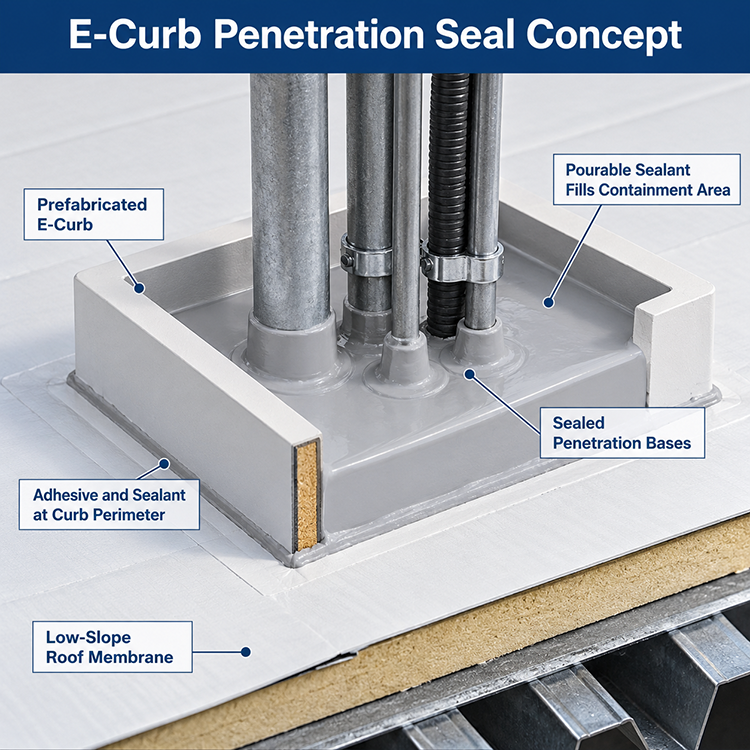
In plain language, E-Curb creates a prefabricated curb around the roof penetration to hold the sealing material in place. The curb forms a defined pocket around the penetration, while compatible adhesive and sealant secure the components and a pourable sealant fills the space inside.
This is different from relying on a bead of sealant around the base of an awkward or irregular penetration. The E-Curb system creates a contained area that allows the pourable sealant to surround the penetration. The detail still has to match the roof membrane and penetration configuration, with proper spacing, surface preparation, and application. The prefabricated curb helps create the detail, but it does not replace those requirements.
Chem Link’s E-Curb Product Data Sheet identifies three basic parts of the standard E-Curb system:
Precast E-Curb exterior rings, straight pieces, and corner pieces that can be arranged around different penetration layouts.
M-1® Structural Adhesive/Sealant, used by Chem Link for bonding the E-Curb components and sealing or preparing the penetration within the documented system.
1-Part® moisture-cure pourable sealer, used to fill the pocket and form the seal around the penetration.
Chem Link also offers the curb components in multiple shapes and sizes. That configurability is one reason the system can be considered for penetrations that are grouped, irregular, or difficult to surround with a single conventional flashing accessory. The exact component arrangement should follow the current documentation for the actual roof and penetration condition.
How Is E-Curb Different From a Bead of Sealant or a Traditional Pitch Pan?
A bead of sealant is not the same detail
Field-applied sealant can be appropriate in many roofing details, but a bead around the base of a penetration and a penetration pocket solve different geometric problems. A bead is typically a joint or transition seal. A pocket creates a contained volume around the penetration so the sealant can surround it within a defined boundary.
That difference becomes easier to see around irregular or grouped penetrations. If several conduits emerge close together, there may be no simple circular boot geometry and very little room to form individual conventional flashings. A configurable pocket may give the designer or contractor another way to create a deliberate detail, provided the roof system and manufacturer requirements support it.
E-Curb and old-style metal pitch pans
Pitch pan, pitch pocket, and penetration pocket are terms that roofing professionals may use for details that contain a pourable material around a penetration. They should not be treated as if every design is identical. Chem Link specifically positions E-Curb as a replacement for old-style metal pitch pans, using precast nonmetallic curb components rather than a field-formed metal pan.
Chem Link’s current product information also states that the E-Curb system does not require flashing or mechanical attachment. That is a manufacturer-specific characteristic of this system, not a general rule for all penetration pockets or all roof penetrations. The surrounding membrane, substrate, and project requirements still determine whether the complete detail is acceptable.
When Might an E-Curb System Be Considered?
E-Curb can be a practical option when the shape or arrangement of a roof penetration makes a conventional flashing detail difficult, or when a dedicated penetration pocket fits the manufacturer’s requirements for the application. But simply being able to build the curb around a penetration does not make it the right solution.
What matters is how the entire detail works with the existing roof system. The membrane, substrate, penetration configuration, movement, spacing, and other project conditions all need to be considered before determining whether E-Curb is appropriate.
Several conduits passing through a low-slope roof in one location, especially when separate boots would crowd one another.
Structural supports or equipment supports with shapes that are not easily handled by a standard pipe flashing.
Solar-panel mounting components or grouped supports where a configurable pocket may simplify the geometry.
HVAC or electrical penetrations with irregular profiles that need more than a perimeter bead of sealant.
Existing penetrations that must be incorporated into a repair, retrofit, equipment change, or roof improvement, after the surrounding roof condition and compatibility are evaluated.
These examples are decision triggers, not automatic product selections. A penetration that looks awkward from ten feet away may still have a better roof-system-specific flashing detail available. Conversely, a penetration that seems simple can become more complicated when the membrane, substrate, movement, or spacing is considered.
The Existing Roof Membrane Changes the Product Decision
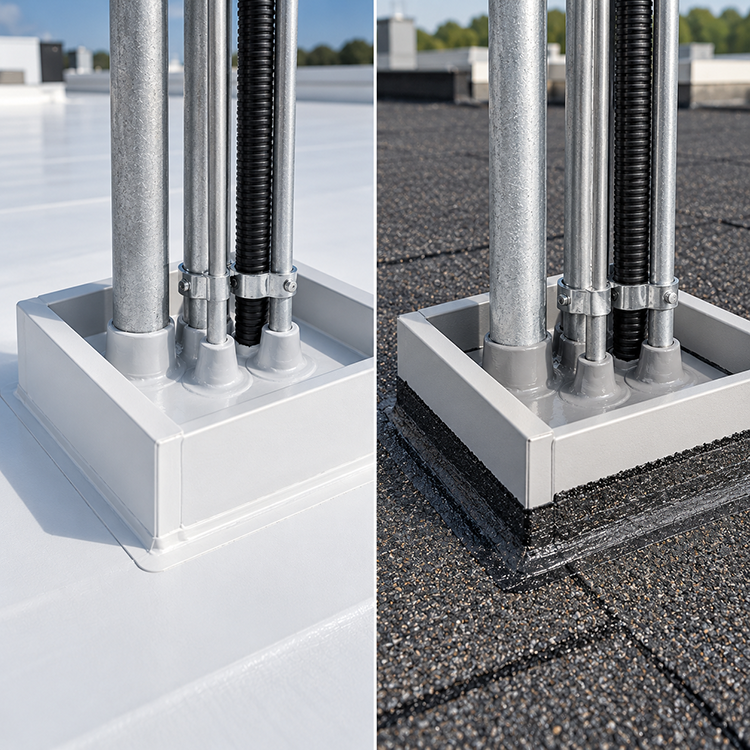
Before selecting a penetration seal system, identify the membrane and the surface to which the curb and sealants will actually bond. Product compatibility is not interchangeable across PVC, TPO, EPDM, built-up roofing, modified bitumen, coatings, and other roof surfaces.
For E-Curb specifically, Chem Link’s current product information identifies applications on granulated modified bitumen, asphalt and coal-tar built-up roofing, plus PVC, EPDM, PIB, and TPO single-ply membranes. Chem Link also states that TPO Primer is required for TPO applications. Those are Chem Link-specific compatibility statements, not a blanket rule for penetration-sealing products from other manufacturers.
This is where product selection can go wrong when the existing roof is not identified first. Two roofs can have nearly identical penetration geometry while requiring different surface preparation, primer, or sealing materials because the membranes are different. The same caution applies when a roof has been coated, repaired with dissimilar materials, or modified over time. The visible top surface is part of the selection problem, not background information.
Spacing and Sealant Volume Are Part of the Detail, Not Afterthoughts
A penetration pocket needs enough room for the sealing material to form the intended geometry around the objects inside it. If the curb is packed tightly against a pipe, conduit, bracket, or neighboring penetration, the available sealant volume changes and the detail may no longer match the manufacturer’s requirements.
Chem Link’s current E-Curb Product Data Sheet specifies 1 inch of space between the penetrations and the inside edge of the E-Curb to provide an adequate seal. It also directs users to Chem Link’s penetration calculator to determine how much sealant the configuration requires.
That makes curb size more than a question of what will physically fit around the penetrations. The selected configuration also needs to provide the required spacing and enough contained volume for the appropriate amount of sealant.
Closely grouped penetrations also raise a practical serviceability question. Will a future technician be able to reach the equipment, remove a component, or understand what is sealed inside the pocket without damaging adjacent work? A clean detail should solve today’s waterproofing problem without making tomorrow’s service work unnecessarily difficult.
Movement, Substrate, and Job Conditions Can Change the Answer
Penetrations do not all behave the same way. A rigid structural support, a small conduit, and an equipment connection can move differently relative to the roof membrane. The substrate beneath the membrane may also affect how the detail is prepared and supported. Those variables are one reason the penetration should be evaluated as part of the roof assembly rather than as an isolated object sticking through the surface.
Environmental and job conditions matter as well. Manufacturer documentation can set requirements for surface cleanliness, primers, acceptable installation weather, cure conditions, and product substitutions for specialized applications. Those requirements should be checked for the current product documentation and the actual roof condition rather than carried over from a different membrane or a previous project.
That system-level view is consistent with our broader discussion of why commercial roof components should be evaluated as an integrated assembly. A penetration detail may occupy only a few square inches or feet, but it still has to work with the membrane, substrate, surrounding flashings, and the building component passing through the roof.
A Practical Selection Framework for Difficult Penetrations
When a penetration is difficult enough that a dedicated seal system is being considered, the most useful questions are usually more specific than “Which sealant should we use?” A contractor, consultant, or specifier can narrow the options by working through the condition in this order:
Identify the roof membrane and the actual bonding surface. Confirm whether the manufacturer lists that roof system as compatible and whether a primer or special preparation is required.
Map the penetration geometry. Count the penetrations, note their shapes and spacing, and determine whether a standard boot or conventional flashing detail is still practical.
Evaluate movement and support. Consider how the penetration and roof assembly may move relative to one another and whether the proposed detail is intended for that condition.
Confirm pocket size and sealant volume. Verify the required clearance around penetrations and the volume of sealant needed for the selected configuration.
Check project conditions and current instructions. Surface preparation, weather, slope, specialized roof surfaces, and manufacturer requirements can change the materials or procedure.
Consider future serviceability. Make sure the chosen detail does not create an avoidable obstacle for future equipment work, replacement, or roof repairs.
This framework is not a substitute for the manufacturer’s details or the project specifications. Instead, it helps establish what needs to be known before choosing a product or penetration-sealing approach. That becomes particularly important during repair and retrofit work. An existing roof may include older materials, previous sealants, coatings, repairs, or modifications that are not documented. Those conditions need to be identified and considered before determining which products and details are appropriate.
New Construction and Existing-Roof Work Start From Different Information
In new construction, the penetration detail can often be coordinated with the roof-system design before equipment and supports are fully installed. The membrane, substrate, penetration locations, and manufacturer requirements are known or can be specified together. That makes it easier to plan clearances and select compatible components before the roof becomes crowded.
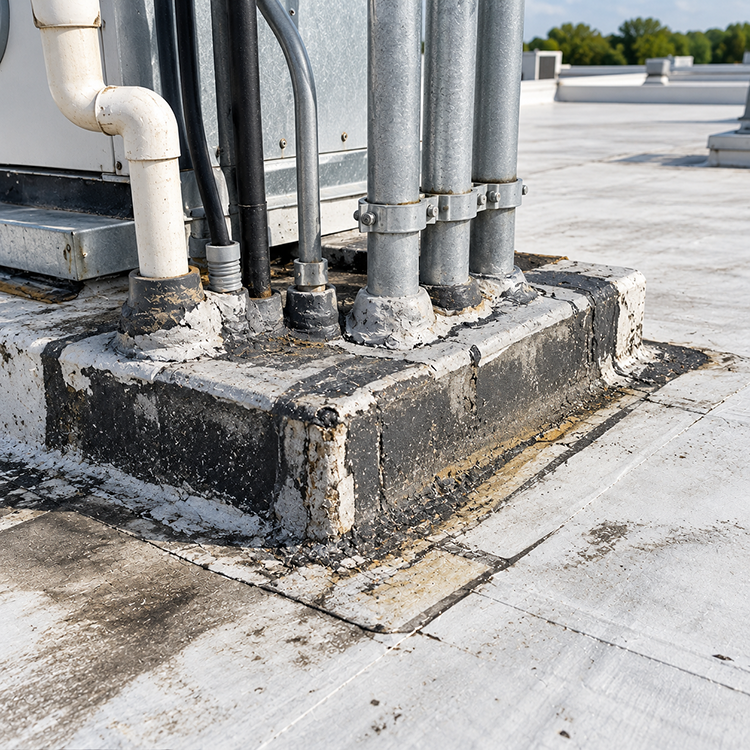
On an existing roof, the first challenge is often discovery. The penetration may already have old sealant, mastic, a metal pitch pan, coating, repair materials, or multiple generations of work around it. Before converting that area to a different penetration-seal approach, the existing materials and surrounding membrane need to be identified so the new detail is based on the actual assembly rather than an assumption.
How Mainline Building Solutions Supports Penetration-Detail Decisions
As a manufacturer representative, we help roofing contractors and project teams sort through product and application questions before material selection becomes a field problem. For penetration sealing, that can include identifying the roof-system context, reviewing product compatibility considerations, and connecting the project to current manufacturer information for the detail being considered.
E-Curb is one Chem Link solution for difficult roof penetrations, not a universal answer for every opening in a commercial roof. The better starting point is to define the membrane, penetration geometry, project condition, and performance requirements, then evaluate the manufacturer-supported options that fit those facts.
Have a difficult penetration detail or product-compatibility question? Contact Mainline Building Solutions to discuss the roof system, penetration configuration, and the Chem Link resources that apply to your project.
DISCUSS MY ROOF SYSTEM DETAILS
Frequently Asked Questions
Is an E-Curb the same thing as a pitch pan?
It serves a similar penetration-pocket function, but it should not be treated as identical to every pitch-pan design. Chem Link specifically describes E-Curb as a replacement for old-style metal pitch pans and uses precast curb components with compatible sealants within its documented system.
Can E-Curb be used on TPO roofing?
Chem Link currently identifies TPO as an E-Curb application and states that TPO Primer is required for TPO single-ply membranes. The current product data and roof-system requirements should be checked for the specific project before installation.
Why not just seal around the penetration with caulk?
A perimeter bead and a penetration pocket are different details. A bead may be appropriate for some joints or transitions, while a penetration pocket creates a contained sealant volume around difficult or grouped penetrations. The correct approach depends on the roof system, penetration geometry, movement, and manufacturer requirements.
What should be known before selecting a penetration seal system?
At minimum, identify the roof membrane and bonding surface, the number and shape of the penetrations, required clearances, movement, substrate condition, slope, environmental conditions, and the current manufacturer instructions. Existing repair materials or coatings can also affect the decision.