

Long term roof performance starts with correct material decisions, and that becomes especially important when it comes to roofing adhesives selection, because adhesive attachment systems influence wind resistance, energy efficiency, installation quality, and long term maintenance outcomes across nearly every modern commercial roof.
Mainline Building Solutions has seen firsthand that adhesives are no longer a secondary accessory in roofing systems. They are often the primary attachment method for insulation, cover boards, and membranes in fully adhered systems. Understanding how they work and where they fail is essential for architects, contractors, and building owners who want predictable performance over the life of a roof system.
This blog breaks down how commercial roofing adhesives function, where they are used, and the most common issues we encounter in the field.
Why Attachment Methods Matter in Commercial Roofing
Attachment method selection directly impacts roof system performance. In commercial roofing, the three primary attachment strategies are mechanical fastening, fully adhered systems using adhesives, and ballasted systems. Each method influences how a roof responds to wind uplift, thermal cycling, and long term movement.
Wind uplift resistance is one of the most critical design considerations. Many projects are designed around standardized uplift resistance levels that define roof assembly performance under controlled testing conditions. These ratings influence whether adhesives are suitable as a primary attachment method or need to be combined with mechanical fastening.
Adhesive systems offer distinct advantages in reducing penetrations through the roof assembly. Fewer penetrations generally means fewer thermal bridges, which improves insulation continuity and can support better energy performance over time. In addition, adhesive attached systems create smoother finished surfaces that improve membrane performance and reduce stress points caused by fastener plates.
However, adhesives also require precise installation conditions. Temperature, substrate preparation, and application consistency all play a direct role in whether the system performs as intended.
Mainline Building Solutions references manufacturer technical data and industry standards during every design review to ensure the attachment method aligns with project conditions.
How Adhesive Technology Has Evolved
Roofing adhesives have advanced significantly over the past two decades. Earlier systems relied heavily on solvent based products with longer cure times and stricter ventilation requirements. Modern systems now include low rise foam adhesives, moisture curing chemistries, and water based formulations designed to improve installation speed and overall application performance.
One of the most important developments has been the expansion of low rise polyurethane foam adhesives. These products allow insulation boards to be attached in a continuous bead or ribbon pattern, reducing fastener use and improving installation efficiency. Many manufacturers now publish standardized coverage expectations and wind uplift performance data based on controlled laboratory testing and field validated performance standards.
This evolution has allowed adhesives to move beyond niche applications into primary attachment systems for large commercial roofs, including fully adhered TPO, PVC, and EPDM assemblies.
We have seen this shift increase consistency in roof performance when adhesives are installed correctly, but it has also increased the importance of proper field training and quality control.
What Are Commercial Roofing Adhesives?
Commercial roofing adhesives are chemical bonding agents designed to secure roofing components together without mechanical fasteners. These components include insulation boards, cover boards, and roof membranes.
Their primary functions include:
Attaching insulation boards such as polyiso or mineral wool
Bonding single ply membranes including TPO, PVC, and EPDM
Securing cover boards for fire resistance and durability
Assisting with flashing and detail work around penetrations and transitions
Benefits of Adhesive Attachment
Adhesive based systems provide several performance and installation benefits:
Reduced roof penetrations compared to mechanical fastening
Improved roof surface continuity with fewer stress points
Better resistance to wind uplift when installed per manufacturer specifications
Potential labor efficiency improvements in large scale projects
Cleaner installation appearance with fewer visible fasteners
These benefits make adhesives particularly valuable in projects where insulation continuity and long term thermal performance are priorities.
Roofing Adhesives Selection: Types of Commercial Roofing Adhesives
Low Rise Foam Adhesives
Low rise foam adhesives are among the most widely used systems in modern commercial roofing. They are typically two component polyurethane products that expand after application to bond insulation boards or cover boards to the substrate.
Common applications include:
Polyiso insulation attachment
Gypsum or high density cover board installation
Fully adhered roofing systems
Advantages:
Fast installation speed
Strong bond strength when properly applied
Reduced fastener usage
Compatibility with multiple substrate types
Limitations:
Sensitive to temperature and humidity
Requires correct bead spacing for performance
Can be affected by uneven substrate surfaces
Bonding Adhesives
Bonding adhesives are commonly used for securing membranes such as TPO, PVC, and EPDM to insulation or cover boards.
There are two primary categories:
Solvent based adhesives
Water based adhesives
Solvent based adhesives typically offer stronger initial tack and faster bonding, while water based systems are often preferred for environmental compliance and reduced VOC emissions.
Performance considerations include open time, coverage rate, and compatibility with membrane chemistry.
Contact Adhesives
Contact adhesives are used in areas requiring immediate bond strength. These are common in detail work where surfaces must hold position instantly after contact.
Typical applications include:
Flashings
Vertical wall transitions
Penetration detailing around pipes and curbs
These adhesives require careful alignment because repositioning is limited after contact is made.
Specialty Adhesives and Sealants
Specialty adhesives are designed for specific conditions such as edge metal attachment or repair applications.
Common uses include:
Edge metal securement
Pipe penetration sealing
Localized membrane repairs
Transition reinforcement areas
These products are often used in conjunction with primary adhesive systems rather than as standalone solutions.
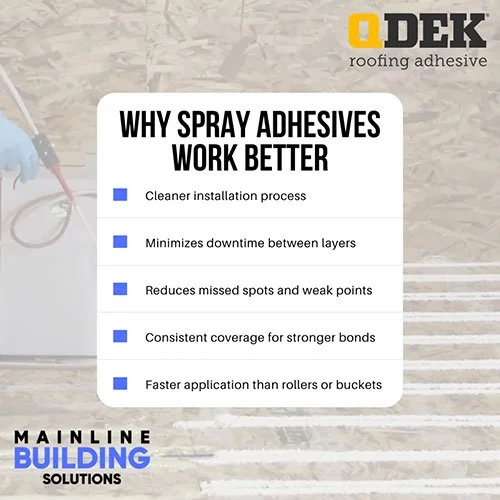
Specialty adhesive systems such as QDEK® adhesives are often used in targeted applications where enhanced bonding performance is required for specific roof transitions or assembly conditions.
Adhesive Attachment vs Mechanical Attachment
Choosing between adhesive and mechanical attachment is a key design decision.
Adhesive Systems Offer:
Fewer fasteners penetrating the roof assembly
Reduced thermal bridging through insulation layers
More uniform load distribution under wind uplift
Smoother substrate surface for membrane installation
Mechanical Systems Offer:
Lower material cost in some assemblies
Faster installation in cold or unpredictable weather
Easier removal during future reroofing projects
Key Decision Factors:
Wind exposure
Project budget constraints
Existing roof condition and substrate stability
Installation timeline and labor availability
Mainline Building Solutions often evaluates both options during preconstruction planning to determine which method aligns best with performance requirements and long term maintenance expectations.
Ensure Long-Term Performance on Your Next Project
Selecting the right adhesive system is not just a material decision, it is a performance decision that impacts the entire roofing assembly.
If you are evaluating adhesive attachment systems, insulation bonding strategies, or full system design for an upcoming project, our team can provide technical support during specification development and field execution.
We help contractors and building owners evaluate:
Adhesive compatibility with membrane systems
Wind uplift requirements based on local code standards
Substrate preparation requirements for long term adhesion
Installation sequencing to avoid moisture related failures
Learn more or connect with our team today.
Which Roofing Systems Use Adhesives?
TPO Roofing Systems
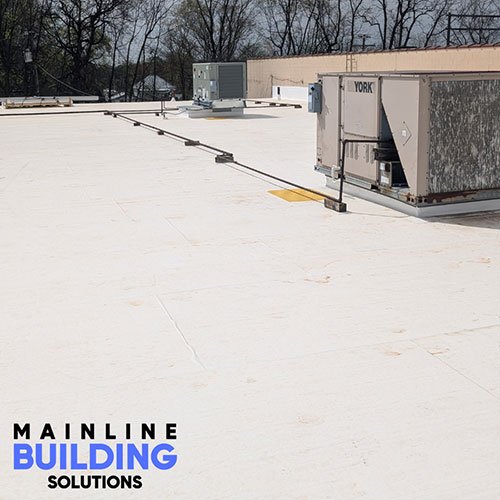
TPO systems frequently use adhesives in fully adhered assemblies. Adhesives are applied to insulation or cover boards before the membrane is rolled into place.
Fully adhered systems provide improved wind uplift performance compared to mechanically attached systems when properly installed and tested.
PVC Roofing Systems
PVC systems require adhesives compatible with plasticizer chemistry. Chemical resistance is important because incompatible adhesives can reduce membrane flexibility over time.
EPDM Roofing Systems
EPDM systems commonly use contact adhesives for both field seams and perimeter bonding. Proper application is critical to ensure long term seam integrity.
Cover Boards and Insulation Attachment
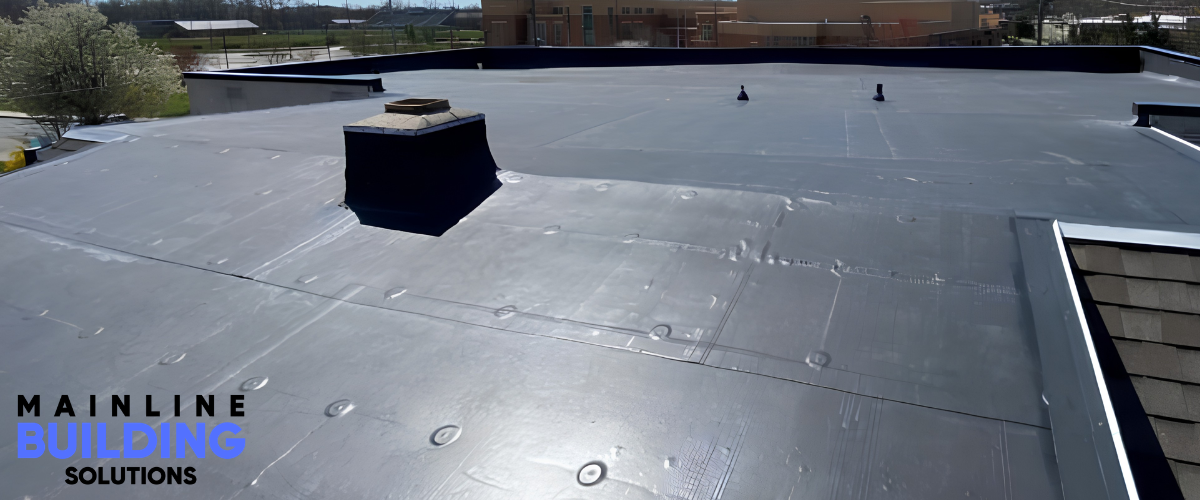
Cover boards such as high density polyiso or gypsum boards are often installed using low rise foam adhesives. These assemblies improve fire resistance, hail protection, and membrane stability.
Factors That Affect Adhesive Performance
Temperature
Most adhesives have manufacturer defined application ranges. Low temperature installation can reduce chemical reaction speed, while high temperatures can shorten open time.
Moisture and Humidity
Excess moisture on the substrate can interfere with bond strength. Trapped moisture can also lead to long term adhesion failure.
Surface Preparation
Proper cleaning and preparation is essential. Dust, oils, and debris reduce bond strength and increase the risk of delamination.
Wind Uplift Requirements
Wind uplift design is often governed by standardized uplift resistance ratings that define roof assembly performance based on building height, exposure category, and geographic region.
Common Commercial Roofing Adhesive Problems
Poor Coverage
Caused by inconsistent bead application or incorrect dispensing equipment.
Inadequate Cure Time
Often due to low temperatures or premature loading of roof materials.
Moisture Contamination
Occurs when adhesives are applied to wet or improperly prepared surfaces.
Delamination
Usually caused by insufficient adhesive volume or substrate incompatibility.
Cold Weather Application Issues
Includes slow cure rates and reduced bonding strength if temperature limits are not followed.
Product Compatibility Issues
Occurs when adhesives are used with incompatible membranes or insulation types.
Best Practices for Installation
We recommend the following installation practices on every adhesive based system:
Follow manufacturer technical data sheets without deviation
Verify temperature and humidity conditions before application
Prepare and clean all substrate surfaces thoroughly
Apply adhesive in consistent patterns with correct spacing
Inspect coverage before setting insulation or membrane
Document installation conditions for warranty validation
These steps significantly reduce the likelihood of premature system failure.
Signs an Existing Roof May Have Adhesive Related Problems
Common indicators include:
Loose insulation boards
Visible membrane wrinkling
Separation between layers
Water infiltration at seams or transitions
Movement or shifting under foot traffic
When these issues appear, early intervention can prevent larger system failures.
Working With Roofing Manufacturers and Technical Representatives
Manufacturer involvement is critical in adhesive system success. Technical representatives provide guidance on:
Product selection based on system compatibility
Wind uplift design compliance
Installation training for field teams
Troubleshooting on active job sites
Mainline Building Solutions coordinates directly with manufacturers to ensure systems are installed according to tested and approved standards. If you need additional resources or project support information, contact our team today.
Conclusion
No single adhesive system is appropriate for every commercial roofing project. Proper evaluation of environmental conditions, structural requirements, and system compatibility is essential to long term performance.
Mainline Building Solutions emphasizes that roofing adhesives selection must always be based on tested performance data, manufacturer specifications, and real world installation conditions. Proper selection and installation are critical to long term roof durability, energy efficiency, and wind uplift resistance.
Understanding the strengths and limitations of adhesive systems allows contractors, architects, and building owners to make informed decisions that improve overall roof performance.
FAQ
Are adhesive systems more expensive?
Material costs can be higher in some adhesive systems, but labor savings and reduced fastener usage can offset total installed cost depending on project size.
How much coverage can I expect from a canister?
Coverage varies by manufacturer and product type. Most low rise foam adhesive systems publish coverage rates in their technical data sheets, typically based on bead spacing and substrate type.
Can adhesives be used during cold weather?
Yes, but only within manufacturer specified temperature ranges. Cold weather often requires modified installation procedures and extended cure times.
When is mechanical attachment a better option?
Mechanical attachment is often preferred in low budget projects, cold weather conditions, or where future reroofing access is a priority.
How do adhesives affect warranties?
Adhesive systems must be installed according to manufacturer specifications to maintain warranty coverage. Deviations can void system warranties.
Which systems are best for reroof projects?
Both adhesive and mechanically attached systems can be used in reroofing, but substrate condition and moisture levels often determine the best approach.